

- Hardwood
The Ultimate Guide to Hardwood Flooring in Indianapolis
March 12, 2026
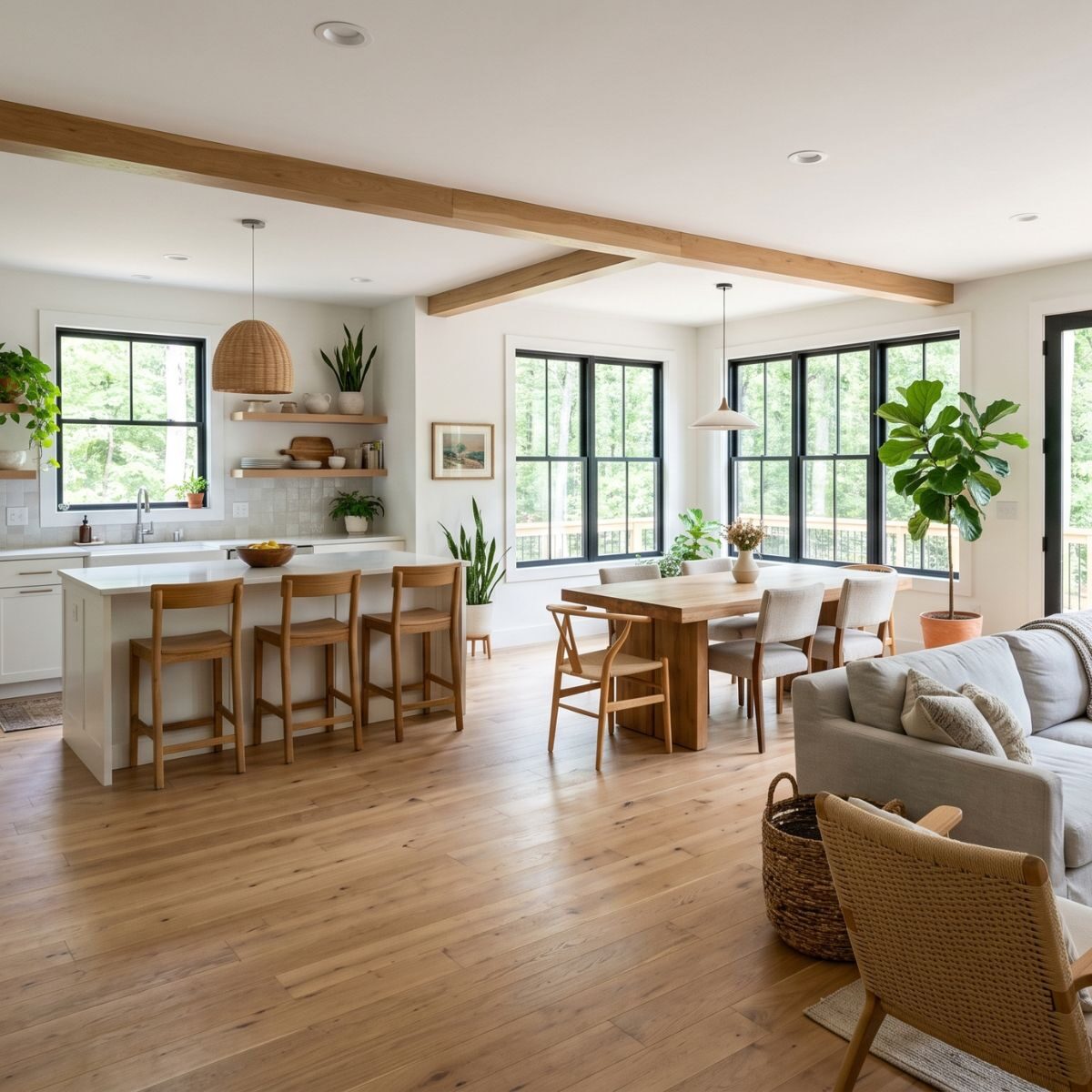
Indianapolis has a flooring problem most homeowners discover in August.
The floors they fell in love with in February, when the house was dry and warm, start to cup or gap once summer humidity settles in. The boards pull away from each other in January. The finish that looked flawless at install develops a faint haze by year two. None of this is bad luck. It is Marion County soil, Indiana’s climate, and a seasonal humidity swing that can exceed 40 percentage points from winter to summer, working together on an under-prepared installation.
This guide is built around that reality. It covers what Indianapolis homeowners actually need to know about hardwood flooring before they buy, what it costs in 2026, which species and construction types hold up in Central Indiana, and how to find a flooring contractor who knows the difference between a showroom pitch and a proper subfloor assessment.
Ready to get started? Book your free consultation with ICC Floors Plus before you make any decisions.
Why Indianapolis Is Harder on Hardwood Than You Think
Most national flooring guides treat hardwood installation as a straightforward process: measure, order, acclimate, install. In Indianapolis, that checklist skips the most critical variable: what is happening beneath the floor.
The Soil Beneath Your Home
Marion County sits on glacial till deposited during the last ice age. The dominant soil association here is the Miami-Crosby pairing: Miami soils with silt loam surfaces and very slow permeability below 2 feet, and Crosby soils, which are silty clay loam and notoriously slow to drain on flat terrain. According to the USDA-NRCS Marion County Soil Survey, Miami soils carry a seasonal high water table between 2 and 3.5 feet below the surface. Crosby soils in lower-lying areas can be even wetter.
For hardwood floors, this matters in two specific ways. First, homes with crawl spaces, which are common in older Meridian Kessler, Broad Ripple, and Irvington neighborhoods, sit directly above soil that moves moisture upward by capillary action and vapor transmission throughout the year. Second, slab-on-grade construction in newer Fishers and Westfield neighborhoods can trap moisture in concrete if vapor barriers were not properly installed during the original build. Without a moisture test before installation, you are guessing. And guessing wrong means cupping, gapping, squeaking, and potential subfloor rot.
Pro Tip from Nate at ICC Floors Plus:
“In neighborhoods around Geist Reservoir and along the lower-lying areas of Washington Township, we consistently see subfloor moisture readings that are higher than expected for the age of the home — a field observation we encounter project after project in those areas, consistent with the poor drainage characteristics documented for Crosby soils in this county. Before we recommend any hardwood product for those locations, we run a full moisture assessment. It takes one visit and it saves homeowners from a very expensive mistake.”
What Indianapolis Humidity Does to Wood
The National Wood Flooring Association recommends maintaining indoor relative humidity between 35% and 55% year-round for solid hardwood installations. Indianapolis averages 70–76% outdoor relative humidity annually, with summer readings routinely climbing above 80% during heat waves. Even with central air conditioning running, many homes do not maintain RH levels below 60% in July and August without a whole-home dehumidifier.
The consequence is predictable. Wood absorbs moisture from the air and expands. With solid hardwood, expansion across the width of a plank means the edges push against neighboring boards. On a wide-plank floor, that pressure can visibly cup the surface. On a properly acclimated and moisture-controlled installation, it may be invisible. The difference is preparation.
Equally important is what happens in January. Indianapolis winters regularly drop indoor RH below 25% as heating systems run continuously, drying the air and causing wood to contract. The same boards that cupped in summer now gap in winter. A 3/4-inch solid oak board can move 1/8 inch or more across its width between seasonal extremes. That is normal and expected, but only if the species, width, and finish were chosen with Indiana’s climate in mind.
Not sure whether your home’s subfloor is ready for hardwood? Schedule a free in-home moisture assessment and we will take the guesswork out of it.
The Climate Swing That Defines Every Flooring Decision
Indianapolis sits at a climate crossroads. In the same year, the city can see temperatures below zero in January and above 90°F in July, a range of more than 90 degrees. Annual precipitation averages 43.6 inches, spread across more than 146 rain days per year. The spring season runs wet, with April averaging the highest number of rainy days. The Indy 500, held each May at the legendary Indianapolis Motor Speedway, takes place right at the heart of the region’s wettest, most transitionally humid stretch.
For hardwood flooring, this means you are selecting a material that will experience dramatic seasonal stress every year for as long as you own the home. Species selection, plank width, and finish all need to account for that stress, not just how the floor looks on installation day.
What Hardwood Flooring Actually Costs in Indianapolis in 2026
Pricing for hardwood flooring in Indianapolis varies based on species, plank width, installation method, and critically, subfloor condition. The numbers below reflect current 2026 contractor market data for the Indianapolis metro.
| Flooring Type | Material/sf | Labor/sf | Total Installed | Notes |
|---|---|---|---|---|
| Solid Hardwood (3/4″ oak/maple) | $5–$12 | $4–$7 | $9–$19 | Add $2–$5/sf moisture barrier on older homes |
| Engineered Hardwood (standard) | $4–$10 | $3–$6 | $7–$16 | Best value for slab-on-grade builds |
| Wide Plank Hardwood (7″–10″) | $8–$18 | $5–$8 | $13–$26 | Premium for herringbone/diagonal patterns |
| White Oak (solid or engineered) | $5–$12 | $3–$7 | $8–$19 | Most-requested 2026 species; slight premium |
| Hardwood Refinishing | — | $3–$8 | $3–$8 | Dustless runs $5–$8/sf; 1–2 days downtime |
| LVP (for comparison) | $2–$6 | $2–$4 | $4–$10 | Ideal for mudrooms, basements, and pet zones |
Several factors specifically drive price variation in Indianapolis. Subfloor condition is the most unpredictable: older homes in Meridian Kessler, Irvington, and Broad Ripple frequently require leveling, moisture barrier installation, or partial subfloor replacement before hardwood can be installed. These costs range from $2 to $5 per square foot on top of the flooring itself. Spring installations can run 10–15% higher due to peak contractor demand in Indianapolis’s busy renovation season, which typically runs April through June.
Material availability also factors in. White oak and wide-plank options sourced from sustainable domestic mills have seen 8–12% price increases since 2025 due to strong national demand.
ICC Floors Plus also offers flexible financing options to help spread the cost of your project — particularly useful for whole-home installs or renovation packages that include hardwood alongside cabinets, countertops, or paint.
Want a quote built around your actual space? Book a free consultation with ICC Floors Plus and we will come to you.
Solid Hardwood vs. Engineered Hardwood: The Real Decision for Indianapolis Homes
There is a version of this comparison that sounds like a sales pitch. Here is the version that reflects what actually happens in Central Indiana.
Solid Hardwood Flooring
Solid hardwood (3/4-inch planks milled from a single piece of wood) is the material people think of when they imagine “real” hardwood floors. It can be sanded and refinished multiple times over its lifetime, which means a properly maintained solid floor can last 80 to 100 years — though that longevity assumes periodic sanding and refinishing every 8 to 15 years depending on traffic and wear.
In Indianapolis, solid hardwood is an excellent choice under specific conditions: above-grade installation with a wood subfloor, proper vapor barrier, and a home that maintains indoor humidity within the NWFA’s recommended range. It is the right choice for older Meridian Kessler Colonials and Tudors with maintained crawl spaces, for formal dining rooms with consistent HVAC control, and for homeowners willing to use a whole-home humidifier in winter and dehumidifier in summer.
It is not the best choice for slab-on-grade construction in newer Carmel and Fishers builds, for below-grade installations, or for any room that experiences humidity swings without active climate control. The species also matters: harder, denser species like white oak, hickory, and hard maple resist surface wear better and are more forgiving of minor moisture stress than softer options like pine or American cherry.
All hardwood installations — solid or engineered — also require a perimeter expansion gap of 3/8″ to 1/2″ around the room’s edges to allow the wood to expand and contract seasonally without buckling. This gap is concealed by baseboards and transitions and is both a physical necessity and a warranty requirement for most manufacturers.
“A lot of homeowners in Carmel and Fishers fall in love with wide-plank white oak online and want exactly that,” notes Nate at ICC Floors Plus. “We love that look too. But the first thing we do is ask about their subfloor and basement. A 5-inch plank and a 10-inch plank behave completely differently in an Indiana summer, and if the subfloor moisture hasn’t been addressed, you’re going to have problems regardless of how beautiful the wood is.”
Engineered Hardwood Flooring
Engineered hardwood is real wood: a top layer of genuine hardwood veneer (typically 2–6mm thick) bonded to a cross-ply plywood or HDF core. The cross-ply construction is what makes it more dimensionally stable than solid hardwood. The layers run in opposing grain directions, which limits how much the floor can expand and contract in response to humidity.
For most Indianapolis homes, particularly newer construction in Fishers, Westfield, Noblesville, and Carmel, engineered hardwood is the higher-performance choice. It can be installed as a floating floor over concrete slabs with proper moisture mitigation, handles the region’s humidity swings with less movement than solid hardwood, and now comes in nearly identical looks to solid, including the wide-plank white oak that is one of the most popular hardwood flooring trends for 2026.
Brands like Anderson Tuftex, Shaw, and Mullican offer engineered hardwood lines with wear layers of 3–6mm. Products with a 3mm or thicker wear layer can typically support one light sand-and-refinish, which addresses the one traditional objection to engineered wood. Always verify refinishing eligibility against the specific product’s installation guide before proceeding, as wear layer depth determines whether and how many times a floor can be sanded.
“Engineered hardwood has come so far that honestly, for most Indianapolis homes, it is the smarter choice, not the compromise,” Nate explains. “You get the same white oak or hickory look, real wood on the surface, but with the dimensional stability to handle our humidity swings. We still sell plenty of solid hardwood in the right conditions, but we are never going to talk someone into something just because it costs more.”
2026 Style Trends Worth Knowing
The biggest design shift in hardwood flooring heading into 2026 is toward warmth, texture, and wider planks. White oak hardwood flooring is among the most requested species in Indianapolis showrooms — a trend reflected in ICC Floors Plus’s in-store traffic and consistent with broader national data from flooring industry reports. White oak is favored for its open grain, subtle warm tones, and compatibility with both transitional and modern interiors. Matte and satin finishes have largely replaced high-gloss in new installations because they hide everyday scratches and show less dust.
Wire-brushed wood flooring has also gained significant traction in Carmel and Zionsville renovations. The wire-brushing process opens the grain slightly, adding texture and character while making the floor more resistant to visible surface wear. Wide plank hardwood flooring in 7- to 10-inch widths has become a standard request in open-concept great rooms, where the fewer seams and broader boards create a cleaner, more architectural look.
For homeowners designing new builds or full renovations, herringbone wood floor patterns are a growing request in formal entryways and primary suites. This installation typically adds $3 to $5 per square foot in labor over a standard straight lay, but delivers a custom detail that is impossible to replicate with big-box flooring and clearly signals designer intent from the moment someone steps through the door.
“I love my new floors. Kim T. was terrific to work with at ICC Floors. She helped me with all my questions, made the process easy, and even came to my home to help me with flooring samples. The entire installation process and team were quick and professional. In the end, I have beautiful new hardwood floors! Thanks to the entire crew at ICC Floors.” -Tiffany H.
“The team at ICC Floors was terrific to work with… They answered all my questions, made the process easy, and even brought flooring samples to my home. The installation was quick and professional, and now I have beautiful new hardwood floors!” – Lawrence G.
Use ICC Floors Plus’s Room Visualizer to preview any of these options in your actual space before you commit to a direction. You can also browse our in-stock hardwood selection for options available for faster installation.
Living With Your Hardwood Floor in Indianapolis: The Seasonal Care Reality
Installation day is not the finish line. How you care for hardwood floors through Indianapolis’s seasonal extremes determines how long they look the way they did when you first walked on them.
Summer: Managing Humidity is the Job
From June through September, the goal is keeping indoor relative humidity below 55%. A central air conditioning system helps, but many Indianapolis homes, especially in older Washington Township neighborhoods and Geist waterfront properties, need supplemental dehumidification to stay within NWFA’s recommended range.
Signs your summer humidity management is failing: edges of hardwood planks beginning to rise (cupping), difficulty opening interior doors (subfloor swelling), or a faint squeaking that wasn’t present at install. None of these mean the floor is ruined; they mean humidity management needs to be addressed before the problem becomes structural.
For pet owners, Indianapolis’s humid summers accelerate wear on softer wood species. Harder options like white oak, hickory, and hard maple score higher on the Janka hardness scale — white oak comes in around 1,290 lbf compared to pine at roughly 870 lbf — and will better resist the combination of claw scratching and repeated cleaning that comes with dogs and cats.
Winter: Preventing the Dry-Out Gap
Indianapolis heating seasons run long, from roughly November through March. As forced-air furnaces run continuously, indoor RH can drop below 25%, causing solid hardwood boards to shrink across their width and produce visible gaps between planks. This is a natural wood response to low humidity, not a defect or installation failure, as long as the gaps close back up in spring.
To prevent excessive winter gapping, use a whole-home humidifier set to maintain indoor RH above 35%. Portable humidifiers in rooms with hardwood flooring are a reasonable alternative for targeted control.
One maintenance mistake that quietly shortens floor life in Indianapolis: cleaning hardwood with wet mops or steam cleaners. Steam cleaning is particularly damaging, driving moisture directly into the wood grain and finish — and it voids the warranty on virtually every hardwood product on the market. Use a dry microfiber mop for daily cleaning and a pH-neutral, hardwood-specific cleaning product applied with a damp (not wet) cloth for deeper cleaning. Avoid vinegar, diluted multi-surface cleaners, and anything not explicitly formulated for hardwood — acidic or alkaline cleaners dull polyurethane finishes over time, often within the first year or two of regular use.
When to Call a Professional
Surface scratches and minor scuffs can be addressed with DIY touch-up kits matched to your floor’s finish color and finish type. Make sure to match not just the color, but whether your floor has a water-based or oil-modified finish — using the wrong type creates a hazy or mismatched patch that is harder to correct than the original scratch. Cupping that persists beyond the summer season, widespread gapping that does not close in spring, soft or bouncy spots underfoot, and any visible mold or musty odor are all signs to call a professional for a moisture assessment before proceeding with any refinishing work. Connect with the ICC Floors Plus team for a professional assessment if your floors are showing any of these signs.
View ICC Floors Plus’s complete care resources for a full breakdown of hardwood maintenance by season.
Icc did the hardwoods and tile in our home when it was built, and came back to them for a small remodel in a bedroom (carpet to hardwood). Pricing was reasonable; installers professional and did a great job of cleanup afterwards. Did have an issue with incorrect toe moulding but they came back the next morning and fixed it promptly. Will definitely use them for future projects; consider ICC highly recommended
netgardner
How to Choose a Hardwood Flooring Contractor in Indianapolis
The difference between a hardwood floor that lasts 30 years and one that cups in its first summer almost always comes down to one thing: what happened before the first board was installed. Here is what to ask before you sign with any flooring contractor in Indianapolis.
Ask About Moisture Testing Before Anything Else
A reputable contractor will not quote a hardwood installation without visiting the site and testing subfloor moisture. Concrete slabs should be tested using in-slab relative humidity probes per the ASTM F-2170 standard, with probes installed at 40% of the slab depth to capture true moisture conditions — not just a surface reading. Wood subfloors should be tested with a pin or pinless moisture meter. If a contractor gives you a firm price over the phone without a site visit, that is a red flag.
Ask specifically: “What moisture reading do you require before you install hardwood?” The answer should reference specific numbers: most manufacturers require wood subfloor MC below 12% and within 4% of the hardwood product’s own moisture content. For concrete slabs, acceptable in-slab RH is typically 75–80% maximum per ASTM F-2170 — but this threshold varies by product, so a reputable contractor will always verify against the specific manufacturer’s installation requirements rather than applying a single blanket number. Vague answers like “we check to make sure it’s dry” are not sufficient.
ICC Floors Plus includes a free in-home measure as part of its process, which covers a subfloor assessment and an accurate square footage estimate. Schedule yours here — that single visit is where most projects are either set up for success or quietly set up for failure.
What a Proper Quote Should Include
A complete hardwood flooring quote should break out materials, labor, subfloor preparation (if needed), moisture barrier costs, underlayment, trim and transition pieces, and removal of existing flooring if applicable. Watch for quotes that bundle everything into a single per-square-foot number without itemizing prep work: that is often how subfloor issues get skipped.
Also ask about warranty coverage. Manufacturer warranties on hardwood typically require installation by certified professionals and documentation of pre-installation moisture testing. If your contractor cannot provide this documentation, your warranty claim may be denied if problems develop later. See what ICC Floors Plus includes in every installation and read verified customer reviews from Indianapolis homeowners who have been through the process.
Red Flags in Any Flooring Quote
No in-person site visit before pricing. Moisture testing skipped or treated as optional. No mention of acclimation time for the hardwood — solid hardwood needs a minimum of 3 to 7 days to acclimate, though in Indianapolis’s humid summer conditions full acclimation can take 10 to 14 days. True acclimation is complete when the wood’s moisture content is within 2 to 4% of the subfloor’s, not after an arbitrary number of calendar days. Vague warranty language that does not specify coverage terms. Pressure to skip “unnecessary” steps like subfloor leveling to keep costs down.
ICC Floors Plus has operated in Indianapolis since 1998 and has built its process around these exact steps. Their Shop at Home program brings samples directly to your space if visiting a showroom is inconvenient.
Frequently Asked Questions: Hardwood Flooring in Indianapolis
How much does hardwood floor installation cost in Indianapolis in 2026?
Most Indianapolis homeowners pay between $9 and $19 per square foot for solid hardwood installed, or $7 to $16 per square foot for engineered hardwood. A 1,000 square foot project typically runs $10,000 to $18,000 depending on species, plank width, and subfloor condition. Wide-plank or custom-pattern installations can exceed $25 per square foot. Subfloor moisture remediation on older homes adds $2 to $5 per square foot to those totals. The most accurate number comes from an in-home estimate that includes a subfloor assessment. ICC Floors Plus also offers flexible financing to help manage the cost of larger projects.
Does Indianapolis’s humidity actually damage hardwood floors?
Yes, and it is the most common cause of early hardwood floor failure in Central Indiana. Indianapolis averages 70–76% outdoor relative humidity annually, with summer readings regularly exceeding 80%. The NWFA recommends maintaining indoor RH between 35–55% for solid hardwood installations. Without active humidity management, solid hardwood will cup in summer and gap in winter as it responds to the seasonal moisture swings typical of Marion and Hamilton County homes. Engineered hardwood is significantly more resistant to these fluctuations and is often the more practical choice for Indianapolis’s climate, particularly in slab-on-grade or below-grade installations.
How long does hardwood floor installation take from start to finish?
With ICC Floors Plus, the process typically runs four to seven days from consultation to completed installation for an average-sized project. This includes your free in-home consultation and measure (Step 1), product selection, scheduling (Step 3), and the installation itself, which for most residential projects takes one to two days. Hardwood material also requires a minimum of 3 to 7 days to acclimate to your home’s temperature and humidity before installation — and in summer conditions, this can extend to 10 to 14 days. The complete ICC Floors Plus process is designed to manage all of this for you.
When do hardwood floors need to be replaced versus refinished?
Solid hardwood floors can typically be sanded and refinished three to five times over their lifespan, depending on original thickness. If the surface is scratched but structurally sound, refinishing is almost always the better value, typically $3 to $8 per square foot compared to full replacement at $9 to $19 per square foot or more. Signs a floor needs replacement rather than refinishing: boards are severely cupped and have not flattened after moisture control was addressed, the subfloor beneath is damaged or rotting, more than 25% of boards have structural cracks or breaks, or the wear layer on engineered hardwood has been sanded to the point where the core is exposed.
Is hardwood flooring a good investment for Indianapolis homes?
Consistently yes, particularly for the mid-to-upper-tier homes in Carmel, Fishers, Zionsville, Geist, and Meridian Kessler that make up most of ICC Floors Plus’s customer base. Hardwood flooring is one of the few renovation investments that buyers will pay directly for at resale, and it typically returns a strong percentage of its cost in added home value. The misconception to avoid: believing that any hardwood installation will hold its value. A floor installed without proper moisture management and subfloor preparation can become a liability rather than an asset, particularly in Indianapolis’s demanding seasonal climate. Species selection, installation quality, and long-term maintenance are all part of the return on investment.
Book your free consultation with ICC Floors Plus to get an honest assessment of what hardwood flooring would look like in your specific home.
Your Next Step Starts Here
You now know more about hardwood flooring in Indianapolis than most homeowners will ever find in a single place. The Marion County soil, the humidity swings, the species that perform best, what things actually cost, and what questions to ask before you let anyone near your subfloor.
What you do not have yet is a number specific to your home and a pair of eyes on your actual subfloor.
That is what ICC Floors Plus has been doing in Indianapolis since 1998. Six locations across the metro. Showrooms with the leading brands in hardwood, from Anderson Tuftex and Shaw to IndusParquet and Bella Cera. A team that brings samples to your home, tests your subfloor before making any product recommendation, and handles installation with the same crew they have built their reputation on.
ICC Floors Plus 7226 East 87th Street, Indianapolis, IN 46256 317-813-0931
Book your free consultation today. No pressure, no obligation. Just a conversation with people who know exactly what your floors are up against in this city.
About the Author: Nate is a flooring specialist at ICC Floors Plus with years of hands-on experience guiding Indianapolis homeowners through hardwood selection, subfloor assessment, and installation across Marion and Hamilton County. He works out of the Castleton showroom and has seen firsthand how Indiana’s seasonal humidity and glacial soils affect every flooring decision.
- Hardwood