

- Flooring
Laminate Flooring in Indianapolis: Is It Right for Your Indiana Home in 2026?
August 17, 2026

Laminate flooring gets a lot of conflicting advice online. Some sites will tell you it’s a perfectly good substitute for hardwood. Others warn you never to install it near moisture. Both positions are exaggerations.
Here’s the honest answer: laminate flooring for Indianapolis homes can be an excellent choice — in the right room, for the right buyer. And it can be a costly mistake in the wrong room. Indiana’s humidity patterns create specific challenges for laminate that understanding allows you to avoid. ICC Floors Plus has been helping Indianapolis homeowners navigate this decision since 1998.
ICC Floors Plus carries laminate flooring including Pergo, one of the most trusted laminate brands available. Book a free consultation and let’s figure out whether laminate is the right fit, or keep reading for the honest breakdown.
Laminate Flooring in Indianapolis: Why Indiana’s Climate Changes Everything
The core of laminate flooring is a high-density fiberboard (HDF) layer — the compressed wood-fiber layer that gives laminate its rigid structure. HDF absorbs moisture when exposed to it. In Indianapolis, where outdoor humidity averages 70-76 percent annually and indoor humidity in unhumidified homes drops to 25-35 percent in winter, that core goes through significant seasonal movement.
Modern laminate handles some of this movement through floating installation and expansion gaps at the perimeter. What it cannot handle is sustained moisture exposure. When the HDF core absorbs moisture — through seam gaps, edge contact with water, or persistent below-grade vapor — it swells. The surface layer separates or bubbles. That damage is permanent.
“Laminate is a better product today than it was ten years ago, but Indiana homeowners need to understand where it works and where it doesn’t,” says Taylor Dore, Retail Sales Manager at ICC Floors Plus. “Above grade, in a dry room with good humidity control, laminate can be genuinely beautiful and long-lasting. Put it in a basement or a high-humidity kitchen, and you’ll be replacing it within a few years.”
ICC Floors Plus Pro Tip: Indianapolis homes that maintain indoor humidity between 35-65 percent year-round are the ones where laminate performs well. That’s the range the North American Laminate Flooring Association (NALFA) specifies for laminate performance — and it differs from the narrower hardwood range you may have read elsewhere. Homes that run dry in winter and humid in summer without active humidity control create seasonal stress that causes laminate to gap or bubble at the seams. A whole-home humidistat tells you whether your home is in the right range before you invest. — ICC Floors Plus Flooring Team
Where Laminate Works Well in Indianapolis
Above-grade bedrooms and living rooms
The classic laminate use case is a main-floor or upper-floor bedroom or living space where moisture exposure is minimal. Modern laminate flooring from Pergo delivers a realistic wood look, good scratch resistance, and a durability profile suited to medium-traffic living areas. Pergo’s surface technology creates texture variation and sheen levels that approximate real wood grain convincingly. For buyers who want the hardwood aesthetic in a secondary bedroom or bonus room at a lower investment level, laminate is a legitimate option.
Rental properties
Laminate’s cost advantage becomes meaningful for landlords managing Indianapolis rental units where the goal is an attractive floor between tenants. The tradeoff: laminate is less forgiving of the moisture exposure that rental units often see. For units likely to have pets or moisture, LVP is the better long-term investment despite the higher upfront cost.
Where Laminate Fails in Indianapolis Homes
Basements: never.
Below-grade spaces are where Marion County’s clay-heavy soils create hydrostatic moisture pressure at the subfloor. Even without a visible leak, concrete slabs in Indianapolis basements regularly show moisture vapor readings that will damage laminate within months of installation. LVP with a waterproof core or porcelain tile are the correct choices.
Kitchens with any moisture risk.
“Water-resistant” laminate marketing means the surface resists brief moisture contact — it does not protect the HDF core. Most Indianapolis family kitchens are too high-risk for laminate. LVP is the right choice.
Bathrooms: no.
Bathrooms have high humidity and direct water contact. Laminate is not appropriate for any bathroom in an Indianapolis home.
Active pet households.
Laminate’s moisture vulnerability makes it a poor choice for homes with dogs who track in rain and snow from the Indiana outdoors. For pet households, LVP is the correct recommendation.
Laminate vs. LVP: The Question Every Indianapolis Buyer Asks
Because laminate and LVP look nearly identical and often appear at similar price points, this is where most Indianapolis buyers spend the most decision time.
“We get this question every week,” says Nate at ICC Floors Plus. “And our honest answer is that for most Indianapolis homes, LVP is now the better choice. Laminate has a very specific use case — a dry, above-grade room with no pets and good humidity control. Outside of that, LVP wins on moisture resistance, durability, and installation flexibility. The only room where laminate can still make sense is the one where it genuinely won’t see moisture.”
The one area where laminate still holds its own: a very dry, above-grade room where some buyers prefer the specific tactile or acoustic feel of laminate. That’s a legitimate reason to choose it — if the room qualifies.
“I love my new wood floors! David my sales person really helped me a lot through out the entire process and was very patient with me as I figured out the right wood flooring. We have been in our home 18 years and have only use ICC Flooring because we trust them.”
Pamela P., Indianapolis Area — Hardwood Floors
What Drives the Investment in a Laminate Floor
Laminate flooring projects in Indianapolis vary based on square footage, product tier, and subfloor preparation needed. NALFA specifies no more than 3/16-inch variance in 10 feet for laminate subfloors — anything more requires leveling before installation.
One often-overlooked item: underlayment. Standard foam underlayment provides sound dampening but not moisture protection. For any Indianapolis room where the subfloor is concrete or sits above a basement or crawlspace, an underlayment with a built-in 6-mil poly vapor barrier is the right specification — not something every installer includes by default.
Book your free in-home measurement with ICC Floors Plus and the team will assess the subfloor, confirm moisture conditions, and help you decide whether laminate is the right choice before any product is ordered.
Caring for Laminate in Indiana’s Climate
Maintain indoor humidity between 35-65 percent year-round. Use a whole-home humidifier or room-level unit to protect the HDF core through Indiana’s dry winters. Clean with a microfiber mop and a laminate-specific cleaner — apply cleaner to the mop pad, not directly to the floor, since any excess liquid at the seams will work into the HDF core over time. Never steam mop. Do not wax or polish laminate — aluminum oxide surface coatings won’t benefit from wax and will only be dulled by it.
“The crew that remodeled our first floor was on time, efficient, cleaned up afterwards and were very polite.”
Indianapolis Homeowner — First Floor Remodel
What to Ask Before You Buy Laminate for Your Indianapolis Home
Ask about the AC rating. Laminate carries an Abrasion Class (AC) rating from AC1 (light residential) to AC5 (heavy commercial). For an Indianapolis family home main floor, AC3 is the minimum; AC4 handles heavier household traffic.
Ask whether “water-resistant” claims apply to the surface or the HDF core. Surface water resistance does not protect the core from seam moisture. Confirm the room won’t see moisture contact at edges or seams.
Ask about the underlayment specification for any ground-level or above-crawlspace room. Standard foam alone is not sufficient moisture protection.
ICC Floors Plus is a NARI Central Indiana member and has served Indianapolis homeowners since 1998 with six locations across Central Indiana. The free in-home measurement is a no-charge assessment of your space, subfloor, and moisture conditions before any product is ordered.
Frequently Asked Questions
Is laminate flooring water-resistant or waterproof?
Laminate is water-resistant at best — the surface handles brief moisture contact before damage occurs. The HDF core absorbs moisture and swells if water reaches it through seams or edges. This makes laminate a poor choice for bathrooms, basements, or any room in an Indianapolis home where moisture is a regular risk. For those spaces, waterproof-core LVP is the correct choice.
How does Indiana’s humidity affect laminate flooring?
Indianapolis’s seasonal humidity swing — from dry winters to humid summers — causes laminate to expand and contract. Modern laminate handles moderate seasonal movement through floating installation and expansion gaps, but it is not designed for sustained high humidity or direct moisture contact. NALFA specifies maintaining indoor humidity between 35-65 percent to protect laminate from seasonal stress in Indiana’s climate.
Can I install laminate in my Indianapolis basement?
No. Laminate is not appropriate for below-grade installation in Indianapolis. Marion County’s clay-heavy soils create hydrostatic moisture pressure at below-grade subfloors. LVP with a waterproof core or porcelain tile are the correct choices for Indianapolis basements.
What is the difference between laminate and LVP?
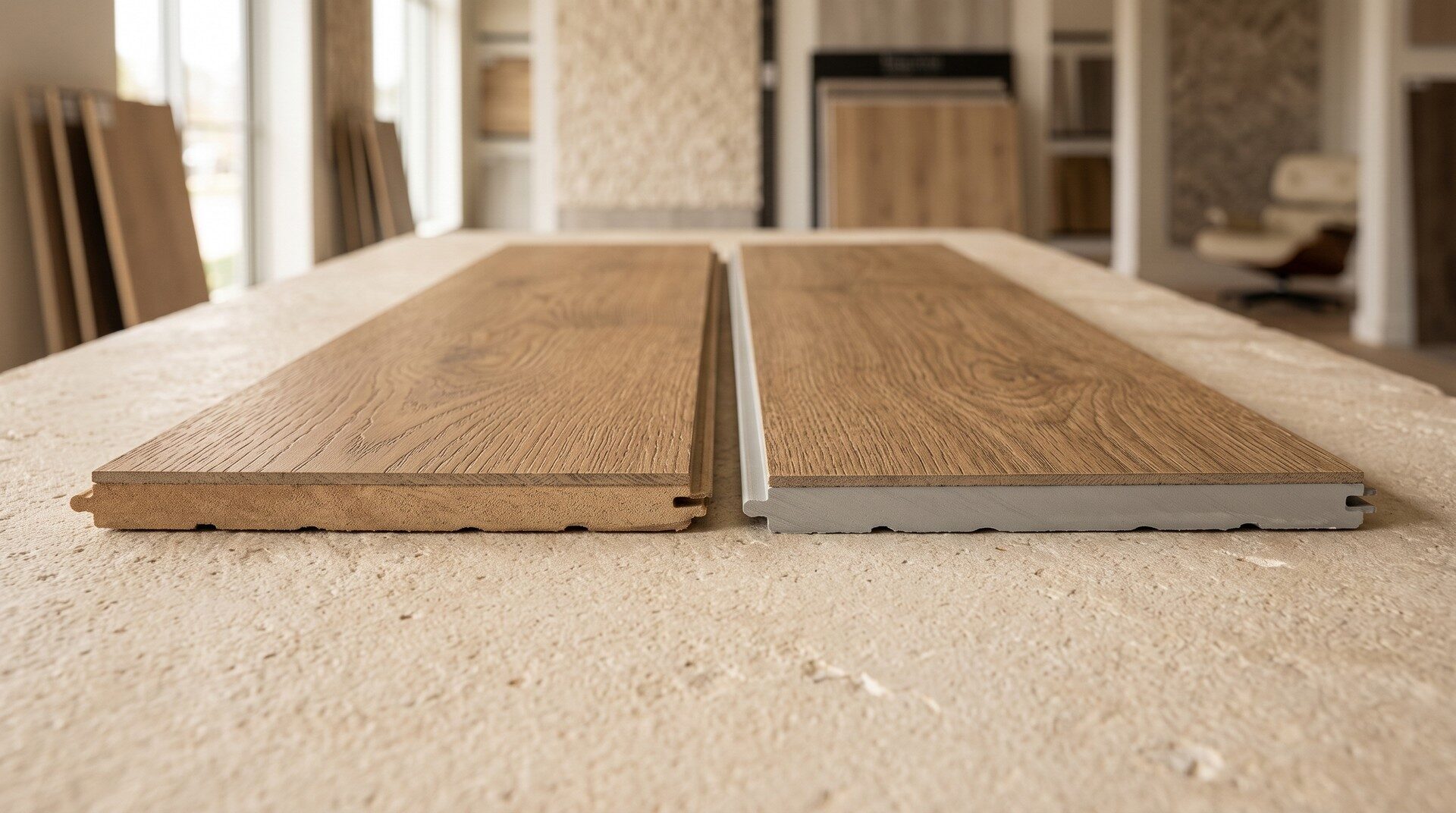
Laminate has an HDF core with a photographic image layer topped by a protective surface coating. LVP has a plastic composite core (SPC or WPC) with a photographic image layer and a wear layer. The plastic core makes LVP waterproof; the wood-fiber core makes laminate moisture-sensitive. Both can look nearly identical from a standing position. LVP outperforms laminate in moisture resistance, scratch resistance, and installation flexibility.
What AC rating should I look for in laminate for an Indianapolis home?
AC3 is the minimum for residential main floors in an Indianapolis family home — it handles normal foot traffic and everyday use. AC4 is appropriate for higher-traffic main floor areas or active households. AC1 and AC2 are bedroom-only ratings that won’t hold up in main living areas.
Ready to Make a Decision?
Before visiting, try the ICC Room Visualizer to preview how laminate or LVP would look in a photo of your actual space.
When you’re ready, book a free in-home consultation or stop by the showroom at 7226 E 87th St in Indianapolis any day this week. Call (317) 813-0931 to speak with a design consultant directly.
The right floor in the right room is the only goal. Let’s make sure laminate is actually that for your space before you commit.
- Laminate
- Luxury Vinyl
- waterproof
You Might Also Like
-

- Flooring
- Cabinets
October 8, 2026
How to Choose Kitchen Cabinets That Match Your Flooring: A Design Guide for Indianapolis Homes
-

- Flooring
- Rugs
September 15, 2026
Area Rugs and Stair Runners for Indianapolis Homes: A Design Guide for 2026
-

- Flooring
August 10, 2026
How to Choose Flooring for a Full Home Renovation in Carmel or Fishers, Indiana