

- Countertops
Quartz vs. Granite Countertops for Indianapolis Kitchens: Which Should You Choose?
October 6, 2026
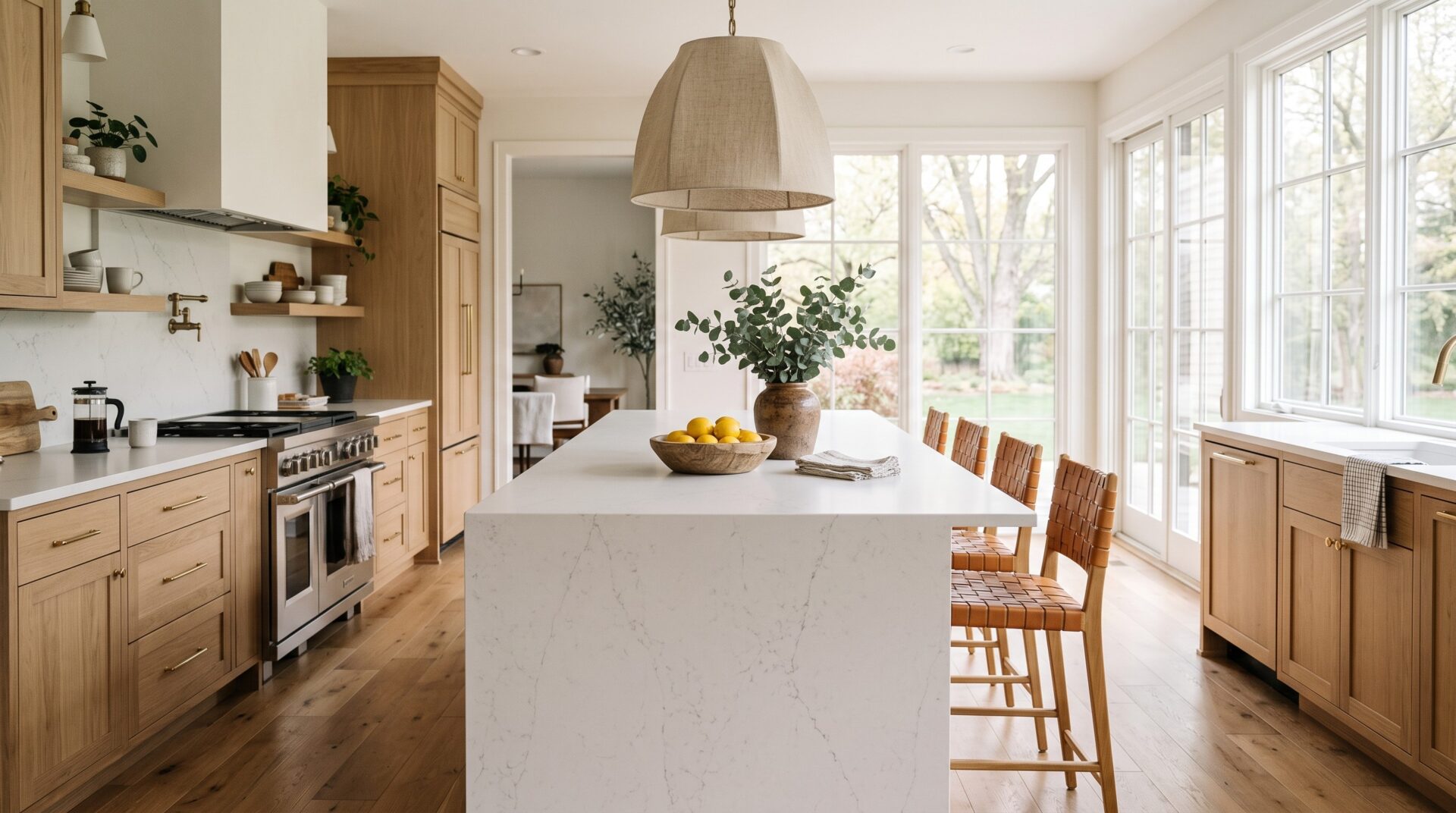
Every Indianapolis kitchen remodel eventually arrives at the same question: quartz or granite? Both are premium countertop materials. Both photograph beautifully. Both last decades when properly cared for. For Fishers and Carmel homeowners facing the quartz vs. granite countertop decision, the right answer depends on how you actually use the kitchen — not on which material is trending.
ICC Countertops in Fishers carries quartz from Cambria, Caesarstone, and Silestone, and granite options from leading stone suppliers. Book a free consultation at 9715 Kincaid Dr in Fishers or keep reading for the honest comparison.
Why Indianapolis Kitchen Countertops Are a Different Decision Than Elsewhere
Central Indiana’s climate and water create specific conditions that national buying guides don’t address.
Indianapolis averages 70-76 percent outdoor relative humidity annually. The seasonal humidity variation common in Indiana homes can accelerate sealant wear on granite faster than it would in a more stable climate. The Fishers and Carmel area also has moderately hard water — typically around 150-200 mg/L as calcium carbonate (about 8-12 grains per gallon) per municipal water data. Hard water leaves mineral deposits on polished countertop surfaces that become visible over time. Both quartz and granite show hard water spots, but surface porosity determines how quickly they accumulate and how easily they wipe clean.
“In Hamilton County kitchens, we see a lot of open-plan entertaining spaces where the island is the visual focal point of the entire main floor,” says Nate at ICC Countertops. “The choice between quartz and granite in that context isn’t just about durability — it’s about how the surface looks after three years of daily cooking, hard water from the tap, and the occasional red wine spill.”
ICC Countertops Pro Tip: Finish selection matters as much as material selection. A honed or matte quartz finish shows fewer water spots than a high-gloss finish. A leathered granite shows fewer fingerprints and water marks than a polished surface. Before choosing the material, also choose the finish — they’re not the same decision. — ICC Countertops Team
Quartz vs. Granite for Indianapolis Kitchens: The Real Comparison
What quartz actually is
Quartz countertops are an engineered product — typically 90-95 percent ground quartz mineral bound with polymer resins and pigments. The manufacturing process produces a surface that doesn’t require sealing and resists staining from most household substances.
The non-porous nature is quartz’s primary performance advantage. In an Indianapolis kitchen doing heavy daily cooking, oils, acids from tomato sauce, and tannins from red wine don’t penetrate quartz the way they can penetrate granite when sealant has aged. Cambria quartz is manufactured in the United States (Eden Prairie, Minnesota), carries a lifetime residential warranty — the industry-leading standard — and is available in a wide range of colors and patterns.
The trade-off: quartz is not as heat-resistant as natural stone. The issue is rapid temperature change (thermal shock) rather than sustained heat — Cambria and other quartz manufacturers specifically exclude thermal shock damage from warranty coverage. Trivets are not optional with quartz. They are a requirement. UV sensitivity is a consideration for quartz near exterior kitchen windows, primarily for darker colors with higher pigment loading; light neutral quartz is generally less susceptible.
What granite actually is
Granite is natural igneous rock quarried from the earth. No two slabs are identical. The visual variation — the movement, the crystal structure, the uniqueness — is what buyers who value natural stone care about, and no engineered product fully replicates it.
Granite is highly heat-resistant. A hot pan set directly on granite will not damage it. It is also harder than quartz and scratch-resistant under normal kitchen use.
The trade-off: granite is porous and must be sealed annually in an active Indianapolis kitchen. When selecting granite for a large kitchen, request all slabs from the same lot number — natural stone varies significantly even within the same named variety, and lot matching is the only way to ensure visual consistency across your island and perimeter.
Where Each Material Works Best in Indianapolis Kitchens
Choose quartz if:
You run a high-use kitchen where oil, acid, and pigmented liquids are common, and you don’t want the maintenance commitment of annual sealing. Quartz’s engineered uniformity also makes multi-surface color matching easier than granite’s natural variation — a practical advantage in kitchens with both an island and separate perimeter counters.
Choose granite if:
You want the authentic look and feel of natural stone. Heat resistance is granite’s clearest functional advantage over quartz. And for traditional or transitional Indianapolis homes where the warmth of natural stone fits the architectural character better than engineered precision, granite is often the more appropriate choice.
A mixed approach:
A quartz island paired with granite perimeter counters is a deliberate design choice the ICC Countertops team sees regularly in Fishers kitchen projects. When mixing materials, coordinate edge profiles and ensure surface heights match at any point where the two materials adjoin — a height or profile mismatch reads as a mistake, not a design intention.
“The staff here has Expert Knowledge on their product. They helped me with my project from the start to end and I love the choices they helped me make! Also, the price was very reasonable for our kitchen cabinets, flooring and countertops. I do not think they can be beat by any other remodeling store.”
Indianapolis Customer — Kitchen Cabinets, Flooring + Countertops
What Drives the Investment in a Kitchen Countertop Project
Countertop projects in Fishers and Carmel vary based on square footage, material selection, edge profile, number of cutouts, and whether backsplash is included in scope. The factors that most often affect the final number are material tier and edge profile complexity.
“The homeowners who are happiest three years out are usually the ones who matched the material to how they actually cook,” says Taylor Dore, Retail Sales Manager at ICC. “Not the ones who picked the trending choice.”
Book your free consultation at ICC Countertops, 9715 Kincaid Dr #1290, Fishers. Seeing and touching the actual slab is the only reliable way to make this decision.
Caring for Quartz and Granite in an Indianapolis Kitchen
For quartz:
Clean daily with a damp cloth and mild dish soap. No sealing required — ever. Use trivets for hot pots and pans; thermal shock damage is not covered under warranty. For hard water mineral deposits, use a pH-neutral calcium/mineral deposit remover.
For granite:
Wipe up spills promptly. Seal annually — apply penetrating stone sealer to a clean, dry surface free of any soap or cleaner residue, and allow 24-48 hours before heavy use. A simple seal test: drop water on the surface. If it beads, the seal is holding. If it absorbs, seal immediately.
For hard water deposits on granite: use a pH-neutral mineral deposit remover specifically formulated for natural stone. Never use vinegar or other acidic cleaners on granite. As the Natural Stone Institute specifies, acid etches the calcium feldspar minerals in granite, creating dull spots that require professional re-polishing to reverse — whether the granite is sealed or not.
“The crew that remodeled our first floor was on time, efficient, cleaned up afterwards and were very polite.”
Indianapolis Homeowner — First Floor Remodel
What to Ask Before You Choose a Countertop Supplier
Ask whether the showroom carries full slabs or remnants only — full slab selection is essential for matching across a large kitchen. Ask whether installation is in-house or subcontracted. Ask about the warranty; Cambria’s lifetime residential warranty is the industry benchmark.
ICC Countertops is at 9715 Kincaid Dr #1290 in Fishers — a dedicated countertop showroom. ICC Floors Plus is a NARI Central Indiana member and has served Indianapolis and Hamilton County homeowners since 1998. Book your consultation before you commit to any material.
Frequently Asked Questions
Is quartz or granite better for an Indianapolis kitchen?
There’s no universal answer. Quartz is non-porous, requires no sealing, and is more forgiving of daily cooking acids and spills. Granite is natural stone with unique visual character, more heat-resistant, and better suited to buyers who prioritize the look and feel of real stone. The right choice depends on how you use the kitchen.
Does quartz need to be sealed?
No. Quartz is engineered to be non-porous and requires no sealing. This is one of its primary advantages over natural stone in an active Indianapolis kitchen. Granite requires annual sealing to maintain stain resistance.
How does Indianapolis hard water affect countertops?
The Fishers and Carmel area water runs moderately hard (150-200 mg/L as calcium carbonate). Both quartz and granite show hard water mineral deposits, but non-porous quartz is easier to clean because deposits sit on the surface rather than penetrating it. For granite, use a pH-neutral cleaner formulated for natural stone — never vinegar or other acidic cleaners, which etch the stone surface.
What is the best countertop for a Fishers or Carmel kitchen island?
A large island used for daily food prep and entertaining benefits from non-porous quartz, particularly Cambria, because it requires no sealing and resists staining without maintenance. Granite is a strong choice for perimeter counters where the aesthetic character of natural stone is more prominent and use is somewhat lighter.
Can I mix quartz and granite in the same kitchen?
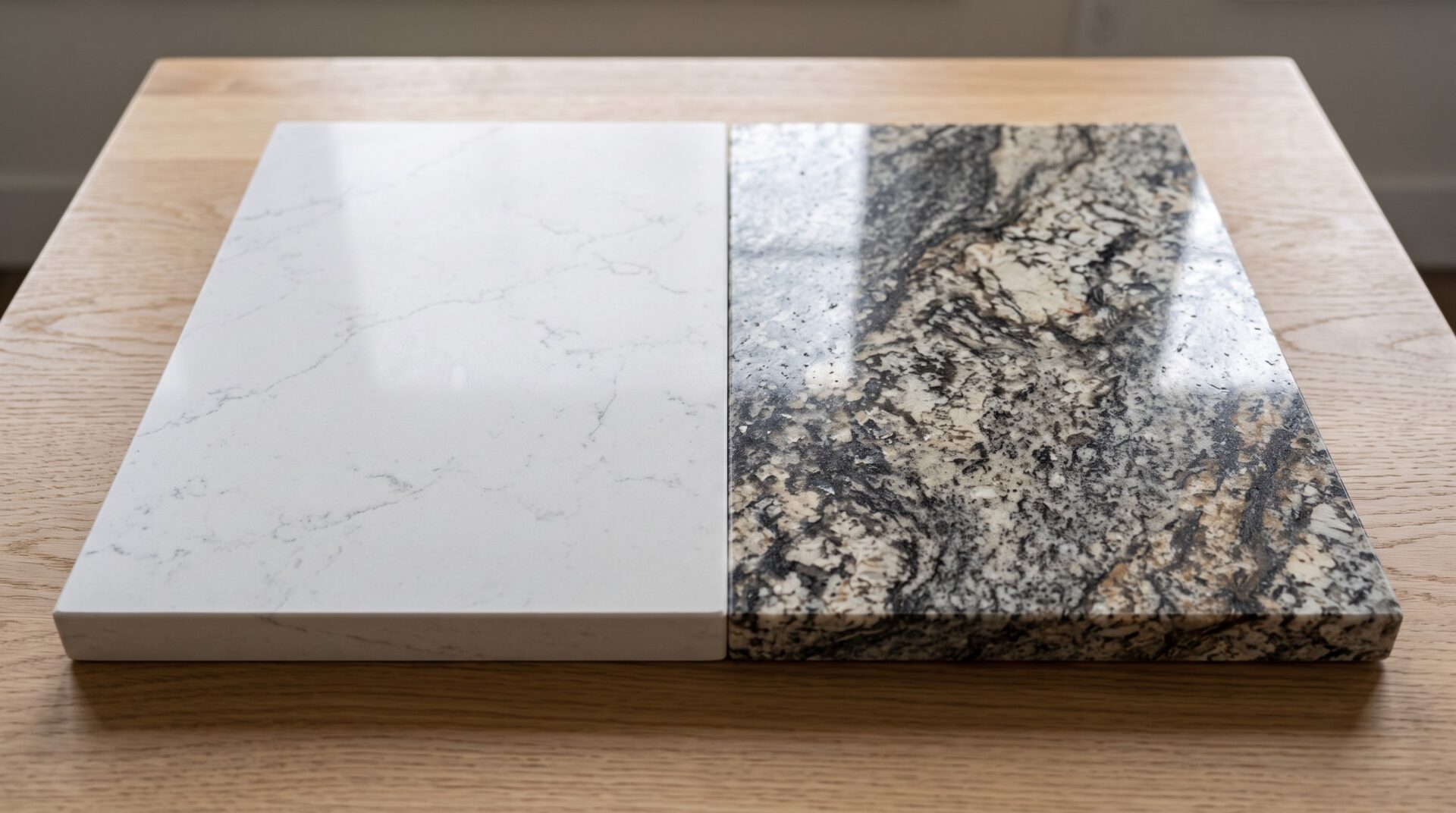
Yes. A quartz island paired with granite perimeter counters is a deliberate design choice the ICC Countertops team supports regularly. The key is coordinated edge profiles and matched surface heights at any point where the materials adjoin. This is a conversation best had in person with samples from both materials side by side.
Ready to See It in Person?
The only reliable way to choose a countertop material is to see and touch the actual slab. Book a free consultation at ICC Countertops, 9715 Kincaid Dr #1290, Fishers, IN 46037 or call (317) 762-6599.
Quartz or granite — the right choice for your kitchen is the one that fits how you actually cook in it.
- Granite
- Kitchen Cabinets
- Quartz