

- Flooring
New Construction Flooring in Crown Point: What Northwest Indiana Builders and Homeowners Choose
June 22, 2026
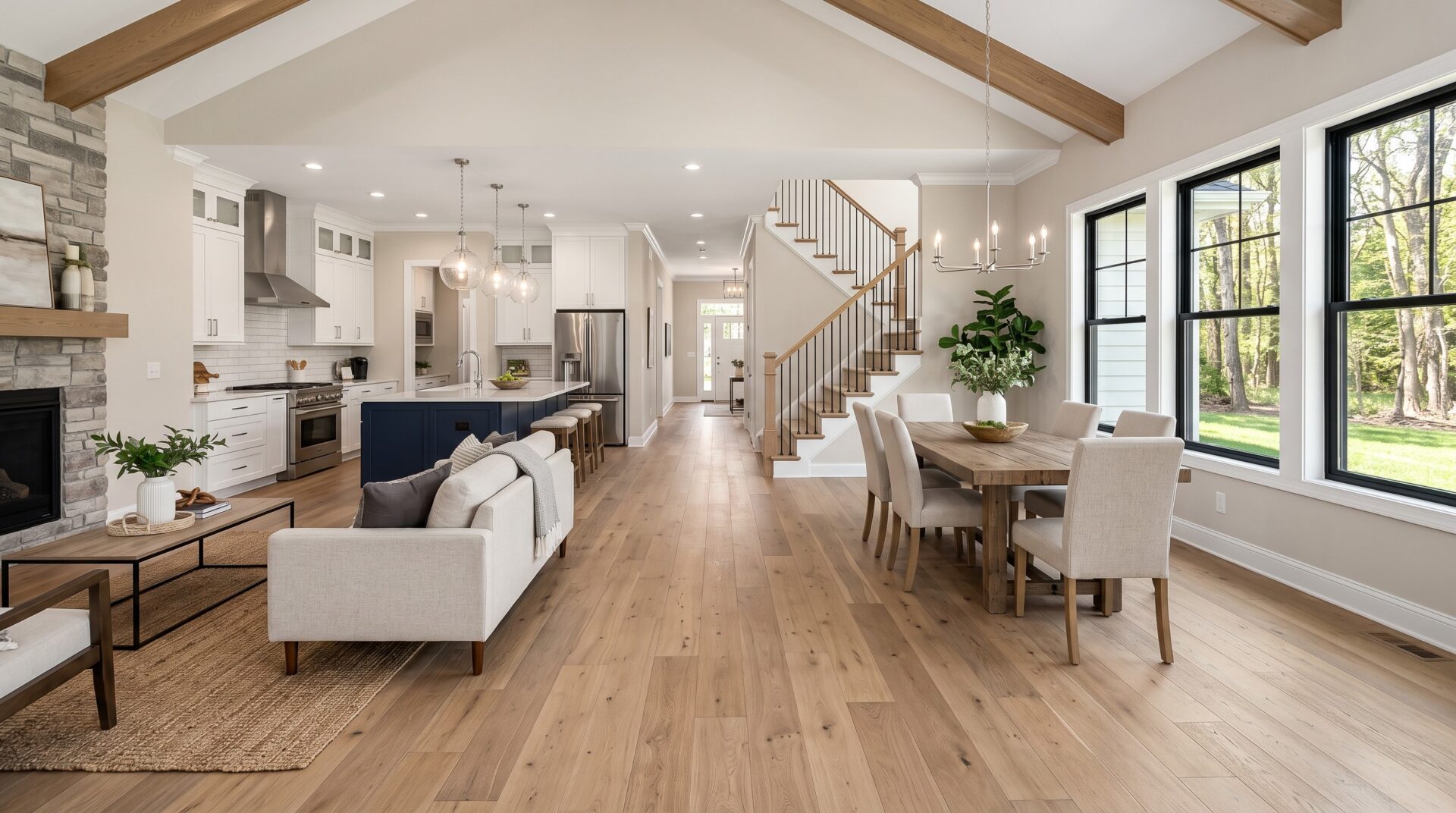
Most people buying a new construction home in Crown Point or Northwest Indiana face a flooring decision at exactly the wrong time: right before closing, when they’re already managing a mortgage, a moving timeline, and a builder who needs an answer by next week. The flooring upgrade package the builder presents looks organized on paper, but it usually represents the volume-negotiated options the builder has arranged with their preferred supplier — not necessarily the best options for how you’ll actually live in the house.
Here’s what most new-build buyers in Lake County don’t know until after they’ve moved in: the flooring allowance your builder gives you can often be applied at an independent showroom. That single fact changes your options for new construction flooring in Crown Point and Lake County significantly.
ICC Floors Plus Crown Point has helped Northwest Indiana families with new construction flooring decisions since 1998. The showroom at 9450 Mississippi St carries product lines that most builder packages simply don’t offer. Book a free consultation before your closing date and let’s look at what’s actually available to you.
Why New Construction Flooring in Lake County Deserves More Thought Than It Gets
New construction in Crown Point and the surrounding Lake County suburbs — Dyer, Schererville, St. John, and Lowell — is active. Developments across the region, from the newer Crown Point sections to communities along the Route 41 corridor, have brought hundreds of homes to market in recent years. Most of them feature the same builder-grade flooring in the same 4-6 finishes.
That’s not a quality failure on the builder’s part. It’s a volume reality. Builders finishing 40-80 homes per development negotiate flooring packages economical to install at scale. The product in their design center is functional and warrantied — and it’s also the same floor that 200 of your neighbors will have.
For buyers who see their new home as both a financial investment and a personal statement, that matters. And for buyers in Lake County specifically, there’s a practical dimension that builder packages often overlook: Northwest Indiana’s humidity patterns require careful material selection for a floor expected to perform for 15-20 years.
“We see Crown Point buyers who come in after closing and realize the builder-grade LVP their neighbor installed is already showing wear or delaminating at the seams,” says Nate at ICC Floors Plus. “The product wasn’t wrong — it just wasn’t specified for how the family actually lives. When you’re spending $400,000 on a house, a few extra conversations before closing can prevent a floor replacement in year three.”
ICC Floors Plus Pro Tip: In new developments built on slab foundations over Lake County’s clay-heavy soils, we consistently request subfloor moisture readings before recommending any hardwood product — even in brand-new construction. In NW Indiana’s wet spring building season, OSB and plywood subfloors can absorb significant moisture during framing. Even in wood-frame construction, a moisture test before flooring installation is warranted. Always ask whether moisture testing was performed before your builder’s flooring went in. — ICC Floors Plus Flooring Team
Using Your Builder’s Flooring Allowance: Builder Package vs. Independent Showroom
When your builder presents a flooring upgrade package, you’re typically looking at two separate questions: should I upgrade, and if so, to what?
The value of upgrading at the builder stage
There’s a legitimate case for some builder upgrades. Installation is bundled into the construction budget, the builder’s crew knows the floor plan, and you don’t coordinate a separate installation after move-in. For buyers who want a clean, simple process, accepting the builder’s upgrade package on a tier or two above base-grade is a reasonable path.
The case for using your flooring allowance at an independent showroom
The alternative — taking your flooring allowance and applying it at ICC Floors Plus Crown Point — gives you access to a different tier of product, a wider range of species and finishes, and a design consultation that takes your actual lifestyle into account.
Builder design centers carry whatever their volume supplier offers. An independent showroom like ICC carries engineered hardwood from Anderson Tuftex and IndusParquet, LVP from COREtec and Shaw Floorte, and carpet from Karastan and Fabrica — product lines that compete on quality, not volume pricing. You see and touch the actual product before it goes in your home.
The tradeoff: you coordinate the installation yourself post-closing. For most buyers who are serious about the flooring decision, it’s worth it.
“The families who take the time to do this before closing almost always tell us afterward that it was the right call,” says Taylor Dore, Retail Sales Manager at ICC Floors Plus. “The ones who wish they’d done it are the ones who moved in, lived with the builder-grade floor for six months, and then came to us to redo it.”
What Actually Holds Up in Northwest Indiana New Builds
Not every flooring type performs equally in Lake County new construction. A few things to know before you decide.
LVP: The dominant choice for main floors
Luxury vinyl plank has become the standard for main living areas in Crown Point and Lake County new builds — and for good reason. COREtec Pro Plus Enhanced and Shaw Floorte collections are visually indistinguishable from real wood in most lighting conditions, and the waterproof core is a genuine advantage in a region where summer humidity regularly exceeds 70 percent.
For new construction specifically, LVP requires only 24-48 hours to come to room temperature before installation. Engineered hardwood needs 3-7 days in the actual room where it will be installed, with HVAC fully operational. In the compressed timeline of a new construction closing, that distinction matters.
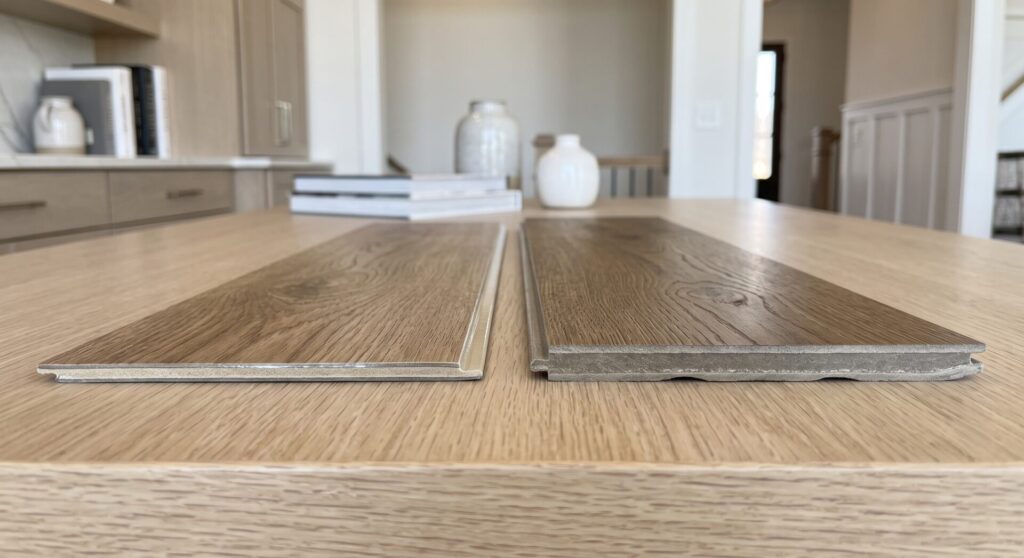
The spec that matters most: wear layer thickness. Builder-grade LVP commonly has 6-12 mil wear layers. For a main floor seeing daily foot traffic from a family for 15 years, the ICC team recommends a minimum 20-mil commercial-grade wear layer. The difference in long-term durability is significant and not visible at install.
Engineered hardwood: The premium choice when timing allows
For buyers who want the authentic look and feel of real wood, engineered hardwood is the right answer — with two conditions. Subfloor moisture must be tested and within acceptable range, and the installation timeline must allow for proper acclimation with HVAC fully operational and maintaining normal temperature and humidity.
Acclimating hardwood in an unheated or unhumidified new build produces misleading readings and can lead to floor movement after move-in. This is a step that separates experienced new construction installers from those who learned flooring in remodel environments.
Anderson Tuftex and IndusParquet offer wide-plank white oak, maple, and hickory options that aren’t available through most builder design centers. The real wood veneer and grain variation creates a look that premium LVP approximates well but doesn’t replicate exactly.
Carpet: Still the right choice for bedrooms and bonus rooms
Most Crown Point new construction buyers opt for hard flooring on the main level and carpet in the bedrooms and bonus rooms. This is the right call. Bedrooms benefit from carpet’s thermal insulation and sound dampening; bonus rooms serving as media rooms or playrooms benefit from the acoustic absorption carpet provides.
The key in new construction carpet is the pad. Builder-grade carpet pad is often thinner than what an independent showroom would specify. The pad directly affects both how long the carpet lasts and how it feels — don’t let the builder’s pad specification be the reason you’re replacing bedroom flooring in five years.
“We decided to replace all carpeting in our home. We had a mixture of both carpet and LVP flooring. We called ICC in hopes of matching our current LVP. We were fortunate enough to have David Robertson as our sales representative. He was absolutely wonderful! So helpful and so very kind. He made the process so easy!”
L. Rabbit, Indianapolis Area — Carpet + LVP
What Drives the Investment in New Construction Flooring
New construction flooring decisions vary based on square footage, product tier, and whether installation is coordinated through the builder or independently post-closing. The factors that most affect the final number at ICC Floors Plus are the product tier selected and whether any subfloor preparation is needed.
The ICC Floors Plus free in-home measurement service applies to new construction. The team can visit before or after closing, assess the subfloor, confirm square footage, and build an estimate that reflects actual site conditions. Book your free consultation before your closing date.
Living With Your New Construction Floor in Lake County
New construction homes take 12-18 months to fully settle. Humidity from construction materials and concrete curing affects indoor conditions in the first year. If you’ve installed hardwood, maintain indoor RH between 35 and 55 percent using a hygrometer and, if needed, a basement dehumidifier. Check and re-secure any transition strips within the first 12 months — new construction settling can loosen them in ways that aren’t visible until you look closely.
For carpet: vacuum weekly with a HEPA filter and schedule professional hot water extraction cleaning within the first 18 months. New construction dust contains fine concrete and drywall particulates that are abrasive to carpet fiber. The sooner it’s extracted, the longer the carpet holds its appearance.
“The crew that remodeled our first floor was on time, efficient, cleaned up afterwards and were very polite.”
Indianapolis Homeowner — First Floor Remodel
What to Ask Before You Choose a Flooring Installer for Your New Build
Whether you’re going through the builder or coordinating independently, a few things to confirm.
Ask whether the installer has experience with new construction subfloors specifically. New construction subfloors may still be adjusting to temperature and humidity, and may not be perfectly level. An installer experienced in new construction knows how to assess and address this before laying the floor.
Ask about the moisture testing protocol. This applies even in brand-new construction — especially in Lake County, where clay-heavy soils retain moisture at the foundation level and spring building seasons bring heavy precipitation. Any installer who tells you moisture testing isn’t necessary in a new home hasn’t worked in Lake County long enough.
ICC Floors Plus is a NARI Central Indiana member and has worked with builders across Central and Northwest Indiana since 1998. The Crown Point showroom at 9450 Mississippi St is open Monday through Saturday. Book your free measurement and the team will assess your subfloor before installation begins.
FAQ
Can I use my builder’s flooring allowance at an independent showroom like ICC Floors Plus?
In many cases, yes — but the answer depends on your builder’s contract terms. Some builders allow the flooring allowance to be applied at any licensed installer; others require their preferred vendor. Before your flooring selection appointment at the builder’s design center, ask directly: “Can I apply this allowance at an independent showroom?” ICC Floors Plus Crown Point can walk you through what your allowance accesses in our product range.
Why does builder-grade LVP wear out faster than showroom LVP?
The difference is almost always wear layer thickness. Builder-grade LVP commonly has 6-12 mil wear layers, which show surface scratching from daily family foot traffic within 3-5 years. Commercial-grade LVP at 20 mil handles the same traffic for 15-20 years without visible wear. Both products can look nearly identical at install — the difference shows up two years later.
Should I choose engineered hardwood or LVP for my new construction main floor in Crown Point?
For most Crown Point families, LVP is the more practical choice for a new construction main floor. Key reasons: only 24-48 hours to room temperature vs. 3-7 days for hardwood acclimation with HVAC operational, waterproof core for NW Indiana humidity, and 20-mil wear layer durability comparable to hardwood. Engineered hardwood is the better choice for buyers who prioritize authentic real wood appearance and whose timeline allows for proper acclimation and moisture testing.
How long before my closing date should I start the flooring selection process?
Ideally, six to eight weeks before closing. This allows time for an ICC measurement visit, product selection, and material delivery and acclimation for hardwood products. If your closing is less than four weeks out, LVP is the more practical choice because installation can follow delivery by 24-48 hours.
Does ICC Floors Plus work with builders directly in Crown Point and Lake County?
Yes. ICC Floors Plus has worked with builders across Central and Northwest Indiana since 1998. If your builder is open to independent flooring suppliers, ICC Crown Point can coordinate with their site team. For buyers purchasing independently post-closing, the process is straightforward: free consultation, measurement, product selection, and installation coordination.
Ready to Look Beyond the Builder’s Package?
The ICC Floors Plus Crown Point showroom is at 9450 Mississippi St, Crown Point, IN 46307. Stop in any day this week.
To book a free consultation before your closing date, visit iccfloors.com/schedule-an-appointment/ or call (219) 500-6650.
Your new home deserves flooring chosen for how you’ll actually live in it — not what was easiest for your builder to install at scale.
- Carpet
- Hardwood
- Luxury Vinyl
You Might Also Like
-

- Flooring
- Rugs
September 15, 2026
Area Rugs and Stair Runners for Indianapolis Homes: A Design Guide for 2026
-

- Flooring
August 17, 2026
Laminate Flooring in Indianapolis: Is It Right for Your Indiana Home in 2026?
-

- Flooring
August 10, 2026
How to Choose Flooring for a Full Home Renovation in Carmel or Fishers, Indiana