

- Flooring
Tile Flooring for Indianapolis Kitchens and Bathrooms: What to Know Before You Buy
July 6, 2026
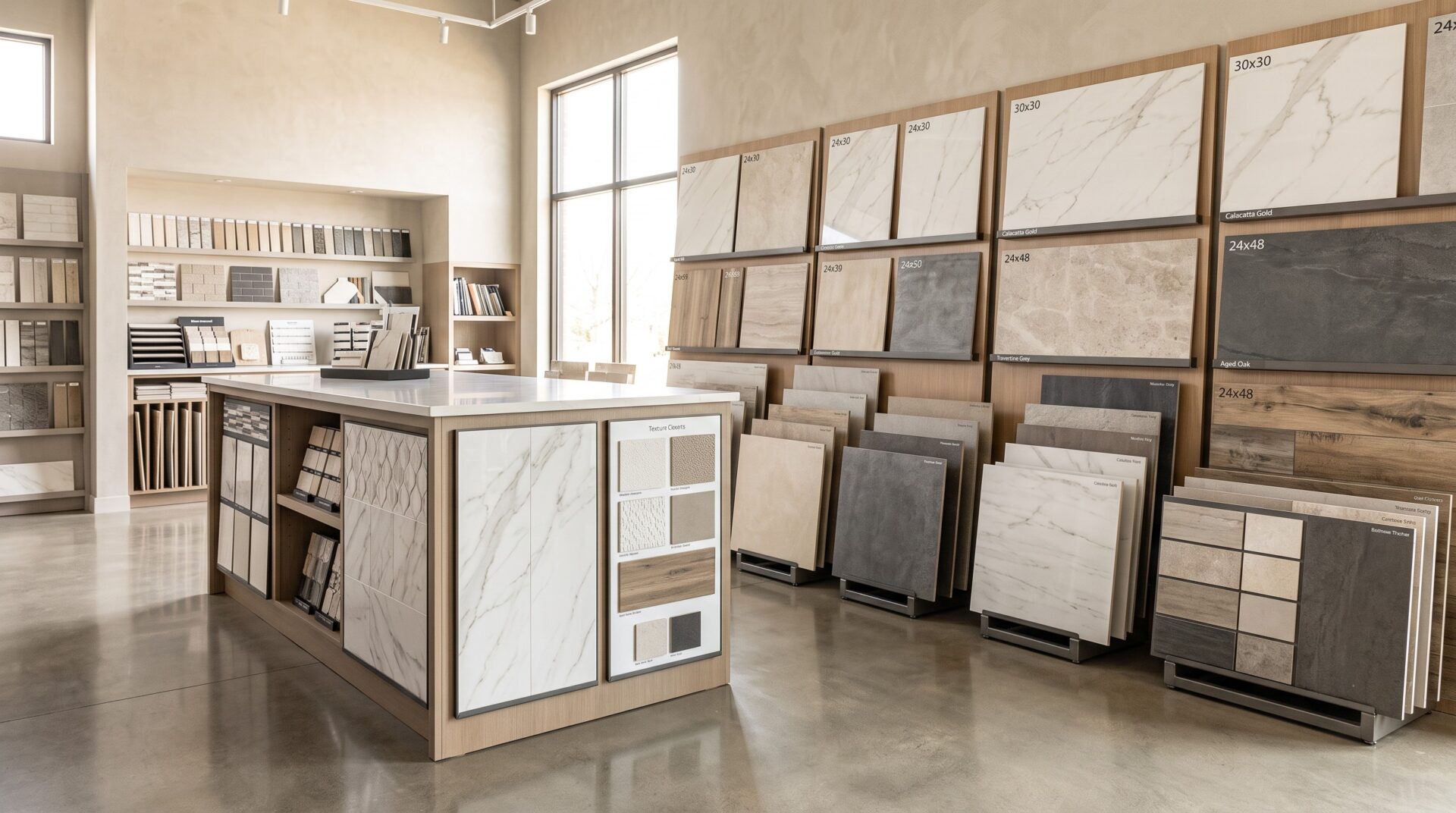
Tile is one of the most durable, moisture-resistant flooring choices available — and one of the most misunderstood. Indianapolis homeowners shopping for kitchen or bathroom tile regularly walk into a showroom knowing they want “something neutral” and leave overwhelmed by the difference between ceramic and porcelain, confused about grout spacing, and uncertain whether the tile they saw at a big-box store is the same quality as what a specialty retailer carries.
It often isn’t. Tile flooring for Indianapolis kitchens and bathrooms requires decisions that look simple on the surface but carry 20-year consequences underneath. The difference between getting it right and getting it wrong usually comes down to subfloor preparation and product quality — two things a big-box customer rarely gets honest guidance on.
ICC Floors Plus carries tile flooring from Daltile and MSI and offers Schluter Systems as a dedicated installation service for tile edges, transitions, and shower waterproofing. Book a free design consultation or stop by the showroom at 7226 E 87th St to see the difference in person.
Why Tile Choices in Indianapolis Kitchens and Bathrooms Matter More Than They Look
Here’s the problem with most tile purchasing decisions: the differences that matter most aren’t visible on the surface.
Indiana’s climate puts tile through specific stresses. Indianapolis averages 70-76 percent outdoor relative humidity annually, and seasonal temperature swings of 50-60 degrees Fahrenheit are common. Tile in kitchens and bathrooms is repeatedly exposed to moisture, temperature change, and cleaning chemicals. The tile that holds up in this environment is not always the tile that looks good on a showroom shelf.
There’s also a subfloor reality specific to Indianapolis. Many of the city’s older homes — in neighborhoods like Irvington, Broad Ripple, and Meridian-Kessler — have subfloors that are older, less level, and more prone to movement than new construction. Tile installed over a subfloor that hasn’t been properly assessed and prepped can crack within the first year, regardless of tile quality.
“In Indianapolis, the most common tile failure we see isn’t a defective product — it’s tile installed by someone who skipped the subfloor prep,” says Nate at ICC Floors Plus. “The homeowner sees beautiful tile that starts cracking at the grout lines within 18 months. The tile is fine. What failed is what’s underneath.”
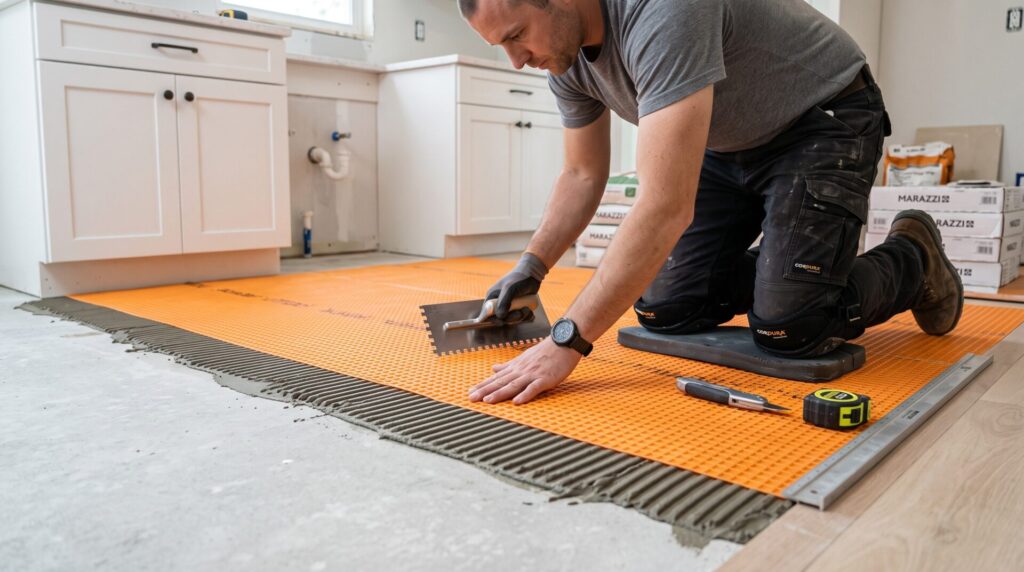
ICC Floors Plus Pro Tip: In older Indianapolis homes with subfloors showing any bounce or flex, we recommend a membrane underlayment before tile installation — often the Schluter DITRA system. Tile is rigid. Subfloors in older homes flex. Those two things don’t coexist without a decoupling membrane. This is the step most big-box tile customers don’t get told about until after the failure. — ICC Floors Plus Flooring Team
Ceramic vs. Porcelain: The Honest Breakdown
Walk into any Indianapolis tile supplier and you’ll see both ceramic and porcelain. They’re often treated as the same thing. They aren’t.
Understanding the performance ratings
The relevant performance rating for kitchen and bathroom floor tile is the PEI wear scale (0-5). PEI 3 is the minimum for kitchen floors; PEI 2 is acceptable for bathroom floors with moderate traffic. Porcelain tile typically achieves higher PEI ratings because of its denser fired body. Fired at higher temperatures, porcelain reaches a water absorption rate of 0.5 percent or less — the ANSI/ISO standard that formally defines porcelain classification.
Ceramic tile, fired at lower temperatures, is generally less dense and absorbs more moisture. This makes it well-suited for walls, backsplashes, and low-traffic bathroom floors — but not the right choice for kitchen floors taking daily foot traffic, dropped items, and cleaning chemicals.
Where each type works best
For Indianapolis homeowners, ceramic makes sense on shower walls, kitchen backsplashes, and bathroom accent surfaces. Porcelain is the correct baseline for kitchen floors and high-traffic bathroom floors.
Large-format tile and what it requires
Large-format porcelain tiles — 24×24 and larger — are the current standard for Indianapolis kitchen and bathroom remodels. Fewer grout lines mean fewer places for moisture to collect. Daltile and MSI both offer large-format porcelain in marble, wood grain, and natural stone looks.
One thing large-format tile demands: a flatter subfloor. Industry standards specify no more than 1/8-inch variance in 10 feet for tiles up to 15 inches, and tighter tolerances for larger formats. Older Indianapolis homes frequently need subfloor leveling before large-format tile can be installed correctly — a step worth knowing about before you fall in love with a 24×48 format.
Schluter Systems in Indianapolis: Why It Matters for Your Tile Project
Most homeowners don’t know the name Schluter Systems until they’ve had a tile project fail. Then they learn about it the hard way.
Schluter produces the metal profiles, membrane underlayments, and waterproofing systems that solve the problems tile on its own can’t. ICC Floors Plus carries and installs Schluter as a dedicated service — not something every Indianapolis tile installer offers.
Schluter DITRA:
A matting underlayment that decouples the tile from the subfloor. When a wood subfloor flexes — as older Indianapolis subfloors do seasonally — DITRA absorbs the movement rather than transmitting it to the tile. This is the single most effective prevention for grout cracking and tile loosening in older homes. DITRA-HEAT is the version designed for radiant heating systems, important for Indianapolis bathroom renovations that include or plan to add in-floor heat.
Schluter KERDI:
A waterproofing membrane for shower walls and floors. KERDI creates a fully waterproof surface behind the tile, protecting wall framing from the moisture that inevitably reaches behind grout lines. In Indianapolis’s humidity, shower waterproofing is not optional if you want the surrounding structure to last.
Schluter edge and transition profiles:
The metal trim pieces that finish tile edges at doorways, transitions to other flooring types, and exposed tile corners. These create the professional, durable finish that a cut tile edge can’t replicate.
“What we tell homeowners is that Schluter isn’t an upgrade — it’s what separates a tile job that lasts from one that needs to be redone in five years,” says Taylor Dore, Retail Sales Manager at ICC Floors Plus. “The product doesn’t cost as much as the conversation about it implies. What it buys you is 20 years instead of seven.”
Learn more about Schluter installation
“The staff here has Expert Knowledge on their product. They helped me with my project from the start to end and I love the choices they helped me make! Also, the price was very reasonable for our kitchen cabinets, flooring and countertops. I do not think they can be beat by any other remodeling store.”
Indianapolis Customer — Kitchen, Flooring + Countertops
What Drives the Investment in a Tile Project
Tile projects in Indianapolis vary based on tile format and material quality, square footage, subfloor preparation needed, and whether Schluter Systems underlayment or waterproofing is included. Projects involving membrane installation or shower waterproofing are more involved than standard floor tile replacement.
The ICC Floors Plus free in-home measurement service assesses the subfloor, measures the space, and produces an estimate reflecting actual site conditions before any tile is ordered.
Book your free design consultation and let the ICC tile team walk through your project before you commit to anything.
Tile Care in Indianapolis: What Actually Works
A few habits specific to Indiana’s humidity keep tile performing through the seasons.
For kitchen tile floors, seal grout annually with a penetrating (not surface-coating) sealer. Unsealed grout in an Indianapolis kitchen absorbs cooking oils, spills, and cleaning chemicals. Light-colored grout in open-plan kitchens needs this most consistently.
In the bathroom, squeegee shower walls after each use to remove standing water from grout joints. Where you can, dry the grout lines as well — the repeated wet-dry cycle at grout joints is where mildew establishes fastest in Indianapolis’s humidity.
For all tile: check expansion joints annually. Tile installed without adequate expansion joints will crack as the subfloor moves through Indiana’s seasonal temperature swings — a pattern particularly common in older Indianapolis homes where original tile was installed without proper joint planning.
“The crew that remodeled our first floor was on time, efficient, cleaned up afterwards and were very polite.”
Indianapolis Homeowner — First Floor Remodel
What to Ask Before You Hire a Tile Installer in Indianapolis
A few things to confirm before signing any kitchen or bathroom tile installation contract.
Ask whether the installer will assess and test the subfloor before beginning. Any installer who quotes without seeing the subfloor is quoting blind — and in older Indianapolis homes, that’s where the problems hide.
Ask about expansion joints and their placement. The Tile Council of North America (TCNA) Handbook specifies expansion joints at perimeter walls and every 20-25 feet of field tile, allowing the floor assembly to accommodate Indiana’s temperature-related movement without cracking.
Ask whether they can install Schluter Systems products. An installer who has never worked with DITRA or KERDI shouldn’t be handling tile installation in Indianapolis bathrooms or over wood subfloors in older homes.
ICC Floors Plus is a NARI Central Indiana member and has served Indianapolis homeowners since 1998. The showroom at 7226 E 87th St in the Castleton area carries Daltile and MSI collections alongside Schluter Systems products. The free in-home measurement includes a subfloor assessment before any product is selected.
FAQ
What’s the difference between ceramic and porcelain tile for an Indianapolis bathroom floor?
Porcelain is denser and absorbs less moisture — 0.5 percent or less per ANSI/ISO standards — making it the right choice for bathroom and kitchen floors that take regular foot traffic and moisture exposure. Ceramic is appropriate for bathroom walls, shower surrounds, and backsplashes where it won’t take physical impact. For any Indianapolis floor that sees regular use, porcelain is the correct baseline.
Do I need Schluter DITRA under tile in my Indianapolis home?
If your subfloor shows any bounce or flex, DITRA is the right call. Wood subfloors in older Indianapolis homes move seasonally as humidity changes, and that movement cracks grout and loosens tile over time. DITRA absorbs that movement before it reaches the tile. New construction over concrete slab may not require DITRA, but it remains the most reliable prevention against future subfloor movement issues.
What size tile works best for Indianapolis kitchens and bathrooms?
Large-format tile (18×18 and larger) is the current standard for Indianapolis kitchen floors and open-plan bathrooms — fewer grout lines mean easier maintenance. For smaller bathrooms or shower floors, smaller tile (4×4 or mosaic) provides better slip resistance. Large-format tile requires a flatter subfloor: no more than 1/8-inch variance in 10 feet for tiles up to 15 inches, so older Indianapolis homes may need leveling first.
How often does grout need to be sealed in Indianapolis?
Annually or every 18 months for high-traffic kitchen tile and bathroom floors. Use a penetrating sealer (not a surface coating) applied after grout has fully cured, typically 72 hours after installation. Surface coatings peel and flake; penetrating sealers absorb into the grout without altering its texture or appearance.
What makes ICC Floors Plus different for a tile project compared to a big-box store?
Product selection, Schluter Systems expertise, and subfloor assessment. ICC carries Daltile and MSI with consistent quality standards. The Schluter Systems installation service means underlayment and waterproofing are handled by the same team doing the tile. The free in-home measurement includes a subfloor assessment before any product is ordered — preventing the most common causes of tile failure in Indianapolis homes.
Ready to Start Your Tile Project?
Preview different tile options in a photo of your actual kitchen or bathroom using the ICC Room Visualizer before you visit.
When you’re ready, book a free design consultation or stop by the showroom at 7226 E 87th St in Indianapolis any day this week. Call (317) 813-0931 to speak with a tile design consultant directly.
The right tile, properly installed, lasts 20-30 years in an Indianapolis kitchen or bathroom. Getting the subfloor and waterproofing right is how you get there.
- Kitchen Cabinets
You Might Also Like
-

- Flooring
- Rugs
September 15, 2026
Area Rugs and Stair Runners for Indianapolis Homes: A Design Guide for 2026
-

- Flooring
August 17, 2026
Laminate Flooring in Indianapolis: Is It Right for Your Indiana Home in 2026?
-

- Flooring
August 10, 2026
How to Choose Flooring for a Full Home Renovation in Carmel or Fishers, Indiana