
- Flooring
Waterproof Flooring Options for Indianapolis Homes: Basements, Kitchens, and Beyond
July 20, 2026
Indianapolis has a flooring problem most homeowners discover the hard way. The carpet in the basement that got wet during spring flooding. The hardwood in the kitchen that cupped after a dishwasher leak. The “water-resistant” laminate that swelled at every seam after a year of Indiana humidity. By the time someone starts searching for waterproof flooring options for Indianapolis homes, they’ve usually already paid to fix the same mistake once.
The right question is “what does waterproof actually mean for a floor?” — because the marketing language doesn’t always match the engineering reality. Waterproof flooring is not a single product category. It’s three different levels of protection, and choosing the right level for each room is what separates a floor that lasts from one that fails again.
Book a free consultation at ICC Floors Plus, or keep reading for the full breakdown.
Why Indianapolis Homes Have a Moisture Problem Most Cities Don’t
Waterproof flooring isn’t a luxury feature in an Indianapolis home. In many rooms, it’s a requirement.
Marion County sits on a geology that combines limestone bedrock with clay-heavy glacial till. Clay soils retain moisture at the foundation level rather than draining it away. When Indianapolis gets heavy spring rain — and it averages 42 inches of annual precipitation — that moisture creates hydrostatic pressure at basement walls and floors. A basement in Indianapolis can have elevated humidity levels simply because of how the soil behaves, not because anything has gone wrong structurally.
On top of that, Indianapolis averages 70-76 percent outdoor relative humidity annually. Kitchens, bathrooms, and laundry areas cycle through repeated exposure to steam, spills, and temperature changes. Traditional hardwood and laminate products weren’t built for this level of environmental stress.
“The most common question we get from homeowners who’ve had flooring failures is ‘what did I do wrong?’” says Nate at ICC Floors Plus. “Usually the answer is nothing — they just chose a product that wasn’t built for the room they put it in. Indiana’s humidity and our soil conditions make waterproof flooring a practical requirement in basements and wet areas, not a luxury upgrade.”
ICC Floors Plus Pro Tip: In Indianapolis homes with basements, moisture risk isn’t always visible. We’ve assessed subfloors that looked dry but showed relative humidity readings above 75-80 percent — the threshold most LVP manufacturers require to be cleared by in-situ probe before installation. At readings above this level, a moisture mitigation step is required before any product goes down. Before installing flooring below grade or adjacent to any wet area, a moisture assessment tells you what product tier you actually need. — ICC Floors Plus Flooring Team
What “Waterproof” Actually Means for Flooring
This is the question that most flooring marketing doesn’t answer clearly. There are three distinct levels of moisture protection in flooring.
Water-resistant:
The flooring resists surface moisture for a limited time. This includes most laminate products and some lower-tier LVP. Surface moisture cleaned up quickly won’t damage the product. Moisture that sits, or that penetrates through seams, will.
Waterproof core:
The flooring plank itself is made from a material that will not absorb water or swell even with prolonged moisture exposure. This is the definition of waterproof for LVP products like COREtec — the plank is the protected component. If liquid gets through the seams and reaches the subfloor, the subfloor can still be affected. The protection stops at the plank itself.
Fully waterproof installation:
The entire floor system — product, seams, and substrate — is protected from moisture. This is what properly installed porcelain tile with Schluter KERDI waterproofing achieves. It’s the only category that provides system-wide protection.
“The three-tier framework is the first thing we walk through with any Indianapolis buyer who’s had a moisture failure,” says Taylor Dore, Retail Sales Manager at ICC Floors Plus. “Most people come in thinking waterproof is waterproof. Understanding that the plank is protected but the subfloor beneath it may not be changes the conversation — and the installation approach.”
Understanding which level each room actually needs is the first step to choosing correctly.
The Right Waterproof Flooring for Each Room
Different rooms have different moisture profiles. Here’s how the ICC team approaches each one.
Basements
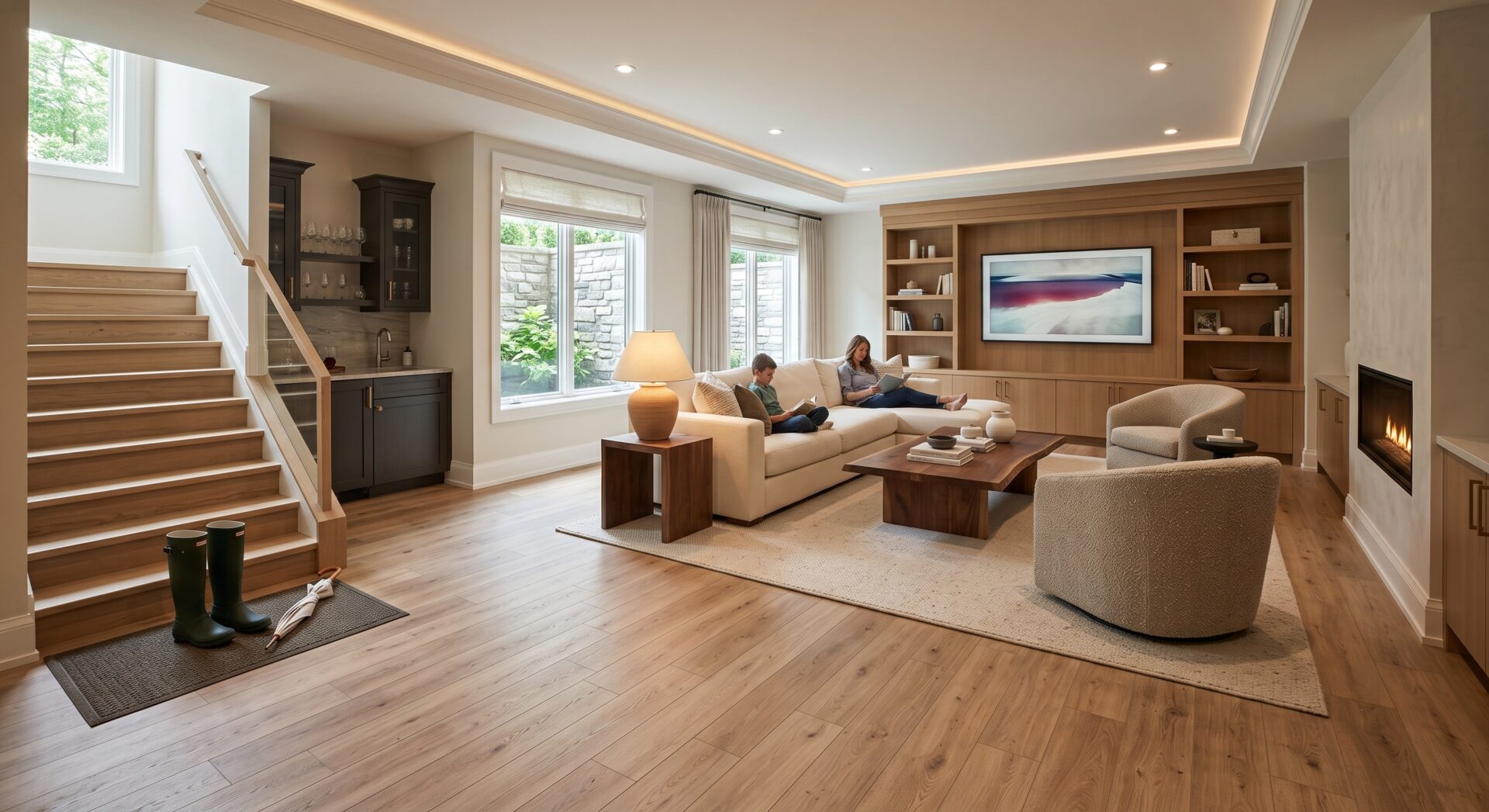
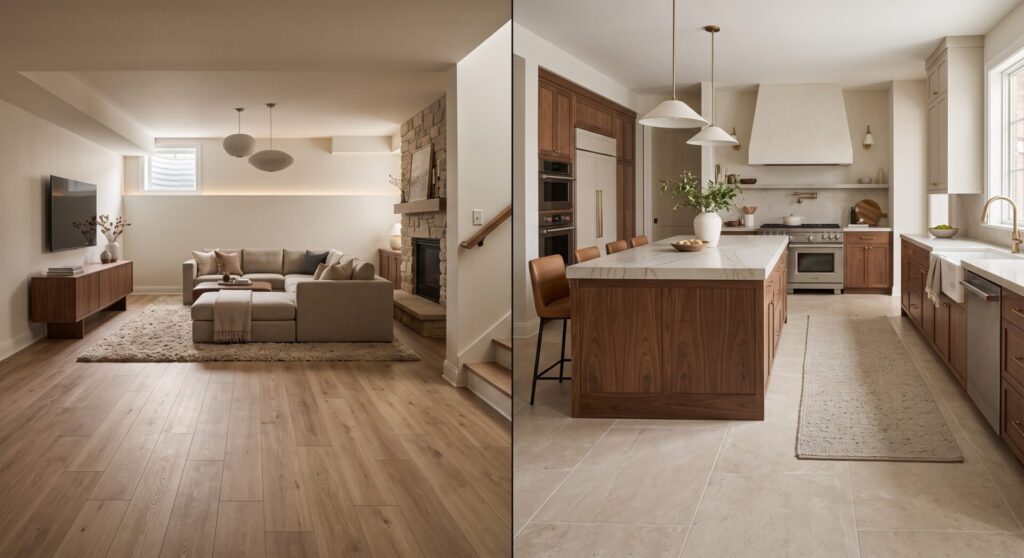
For finished Indianapolis basements, LVP with a waterproof rigid core is the dominant choice. COREtec Pro Plus Enhanced uses an SPC core — meaning the plank will not absorb moisture or swell under normal conditions. Shaw Floorte collections with waterproof rigid cores are a strong parallel option. In a floating installation, if a basement sump fails or a small amount of water intrudes through a foundation crack, the planks can typically be pulled up, dried out, and reinstalled.
The important limitation: if water intrudes in significant quantities and reaches the subfloor, the subfloor can still be affected. For Indianapolis basements with a history of active water intrusion, the foundation issue must be resolved before any flooring goes down.
Try previewing different waterproof flooring options in a photo of your basement using the ICC Room Visualizer before you commit to anything.
Kitchens
Kitchen floors take spills, dishwasher moisture, pet water bowls, and cooking humidity. Waterproof-core LVP handles all of this well. Porcelain tile handles it even better — the material itself is impervious to moisture. The main tradeoff for tile is comfort underfoot. A quality kitchen mat or runner makes that workable while maintaining full moisture protection.
Bathrooms and Laundry Areas
Inside shower enclosures, waterproof-core LVP shouldn’t be used — shower walls and floors need a waterproofing membrane like Schluter KERDI behind the tile. Outside the shower enclosure, waterproof-core LVP or porcelain tile are both appropriate choices. For laundry areas, waterproof-core LVP is the practical choice — it handles regular moisture exposure from appliance connections and occasional overflow without subfloor damage.
“The staff here has Expert Knowledge on their product. They helped me with my project from the start to end and I love the choices they helped me make! Also, the price was very reasonable for our kitchen cabinets, flooring and countertops. I do not think they can be beat by any other remodeling store.”
Indianapolis Customer — Kitchen, Flooring + Countertops
What Drives the Investment in Waterproof Flooring
Waterproof flooring projects in Indianapolis vary based on the room, product tier, square footage, and whether subfloor preparation or moisture treatment is needed before installation. The factors that most often affect the final number are subfloor condition and whether a moisture assessment reveals issues requiring correction.
Book your free in-home measurement at ICC Floors Plus. The team includes a subfloor moisture assessment as a standard part of the no-charge measurement service for any below-grade or moisture-prone space.
Living With Waterproof Flooring: What to Do After Installation
Even the most waterproof product benefits from consistent maintenance habits.
For waterproof LVP: the planks are waterproof, but standing water at the seams over extended periods can work its way down. Clean spills promptly, don’t allow water to pool at doorways after rain, and use a microfiber mop with a pH-neutral cleaner for regular maintenance. Never use a steam mop. Maintain perimeter gaps as installed — if they fill with debris or caulk, the floor can’t expand seasonally, putting stress on seams and eventually breaking the waterproof contact between planks.
For porcelain tile in wet areas: seal grout for the first time 72 hours after installation, before the surface sees moisture, then annually thereafter with a penetrating sealer. The tile is waterproof; unsealed grout is not.
For basements specifically: address the source of moisture, not just the surface. If you see efflorescence (white salt deposits) on basement walls, or if the floor slab feels damp, drainage issues should be resolved before flooring goes in.
“The crew that remodeled our first floor was on time, efficient, cleaned up afterwards and were very polite.”
Indianapolis Homeowner — First Floor Remodel
What to Ask Before You Hire a Flooring Installer for a Wet or Below-Grade Space
Any installer who doesn’t ask about moisture before quoting a below-grade or kitchen project isn’t doing their job. A few things to confirm before signing.
Ask whether the installer will perform a subfloor moisture assessment — relative humidity testing by in-situ probe, not just a visual inspection. A visual assessment misses elevated moisture in concrete that looks dry on the surface.
Ask about seam installation method for LVP. Waterproof LVP is only fully protective if seams are fully clicked together with no visible gaps, and perimeter expansion gaps are maintained.
Ask whether subfloor preparation or leveling is included in the quote. Waterproof flooring over an uneven subfloor develops stress points at seams over time that eventually break the locking mechanism.
ICC Floors Plus is a NARI Central Indiana member and has served Indianapolis homeowners since 1998. The free in-home measurement includes a moisture assessment as a standard part of the site visit for any below-grade or moisture-prone space. Book your consultation before you commit to any product.
FAQ
What is the most waterproof flooring for an Indianapolis basement?
COREtec Pro Plus Enhanced LVP and porcelain tile are the ICC team’s most consistent recommendations for Indianapolis basements. COREtec’s SPC core means the plank will not absorb moisture or swell under normal conditions, and in a floating installation, planks can typically be dried out and reinstalled after minor flooding. Porcelain tile is appropriate for basement bathrooms and utility areas. Neither product is a substitute for a properly waterproofed foundation — active water intrusion must be resolved first.
What does “waterproof core” mean for LVP flooring?
A waterproof core means the plank itself is made from a material (SPC or WPC) that will not absorb water or swell. The protection is the plank — if water gets through the seams in significant quantities and reaches the subfloor, the subfloor can still be affected. Prompt cleanup and proper installation protect both the plank and the substrate beneath.
Can I put waterproof LVP directly on a concrete basement floor?
Yes, with preparation. Most LVP manufacturers require concrete RH below 75-80 percent (measured by in-situ probe) before installation. Indianapolis basement slabs frequently exceed this threshold, requiring a moisture mitigation step. The ICC team includes this assessment in every below-grade flooring estimate, so you know what preparation is needed before any product goes down.
Is waterproof LVP suitable for a kitchen with a dishwasher?
Yes. Waterproof-core LVP handles moisture from dishwasher steam, spills, and general kitchen use. Proper seam closure at the perimeter near high-moisture appliances is the key installation requirement. LVP improperly sealed at edges near a dishwasher can allow water to reach the subfloor over time.
What is the difference between waterproof LVP and water-resistant laminate?
Waterproof LVP has a core that does not absorb water under any conditions. Water-resistant laminate has a wood-fiber core with a surface coating that resists moisture for a limited time. If water penetrates laminate through seam gaps or prolonged contact, the wood-fiber core swells permanently. For Indianapolis basements and kitchens, the distinction is significant — laminate is not appropriate below grade or in high-moisture areas.
Ready to Find the Right Waterproof Floor?
Before you visit, try the ICC Room Visualizer to preview how different waterproof flooring options look in a photo of your space.
When you’re ready, book a free in-home consultation or stop by the showroom at 7226 E 87th St in Indianapolis any day this week. Call (317) 813-0931 to speak with a design consultant directly.
Don’t replace the same floor twice. Get the right one this time.
- waterproof
You Might Also Like
-

- Flooring
- Rugs
September 15, 2026
Area Rugs and Stair Runners for Indianapolis Homes: A Design Guide for 2026
-

- Flooring
August 17, 2026
Laminate Flooring in Indianapolis: Is It Right for Your Indiana Home in 2026?
-

- Flooring
August 10, 2026
How to Choose Flooring for a Full Home Renovation in Carmel or Fishers, Indiana